Real-Time Payment Systems: How Instant Payments Work Worldwide
Here is how the infrastructure works and how the major networks compare.

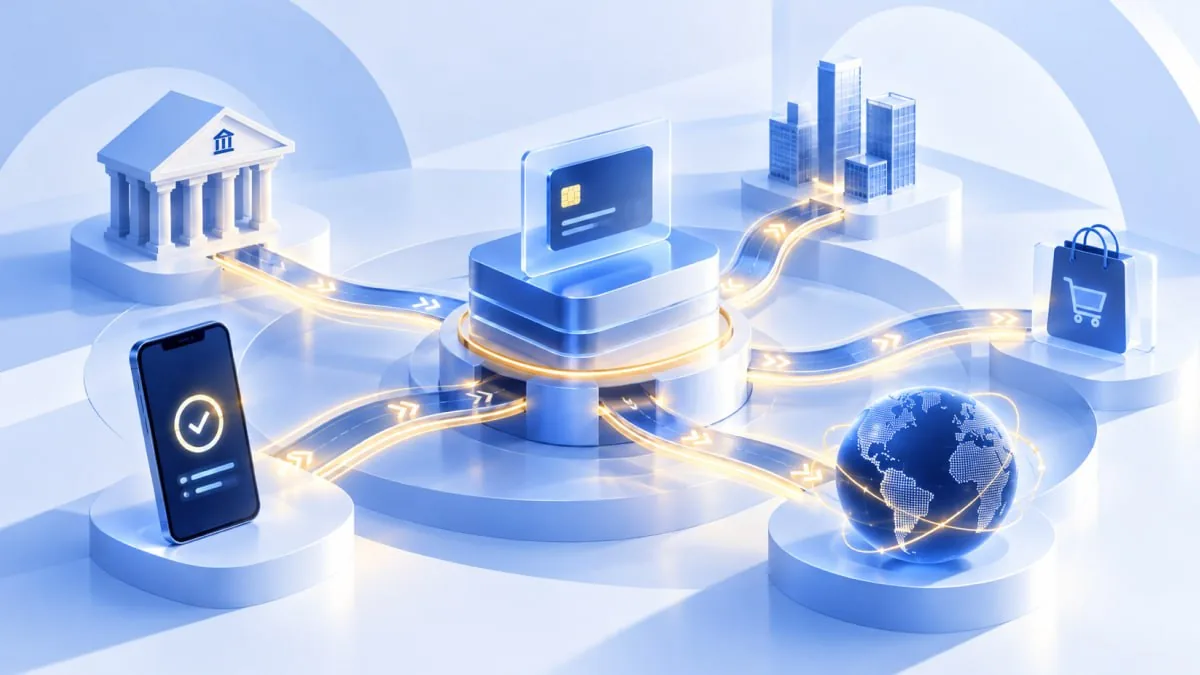
Not long ago, moving money between two bank accounts meant waiting for the next business day. Today a growing share of the world’s account-to-account payments arrive in seconds. Real-time payment (RTP) systems have become a core layer of modern financial infrastructure, sitting underneath mobile banking apps, checkout flows, payroll tools and marketplace payouts.
This guide explains what real-time payments are, how an instant payment travels from payer to payee, how the major national networks around the world compare, and where open banking fits. It is written for business, product and engineering teams that need to understand the infrastructure before choosing or building a payment solution on top of it.
What are real-time payment systems?
A real-time payment system is a payment network that clears and settles individual credit transfers between accounts at different banks within seconds, and makes the funds available to the recipient immediately. The terms real-time payments (RTP) and instant payments are usually used interchangeably. In the United States, “RTP” is also the brand name of one specific network operated by The Clearing House, which we cover below.
Not every fast transfer qualifies. Four properties decide whether a payment system is genuinely real time:
- Processing speed — the payee’s bank credits the account within seconds, not in a later batch.
- Availability — the service runs 24/7/365, including weekends and public holidays.
- Settlement — the obligation between the two banks is settled immediately or fully secured, so funds can be released at once.
- Finality — once confirmed, the payment cannot be unilaterally reversed by the sending bank.
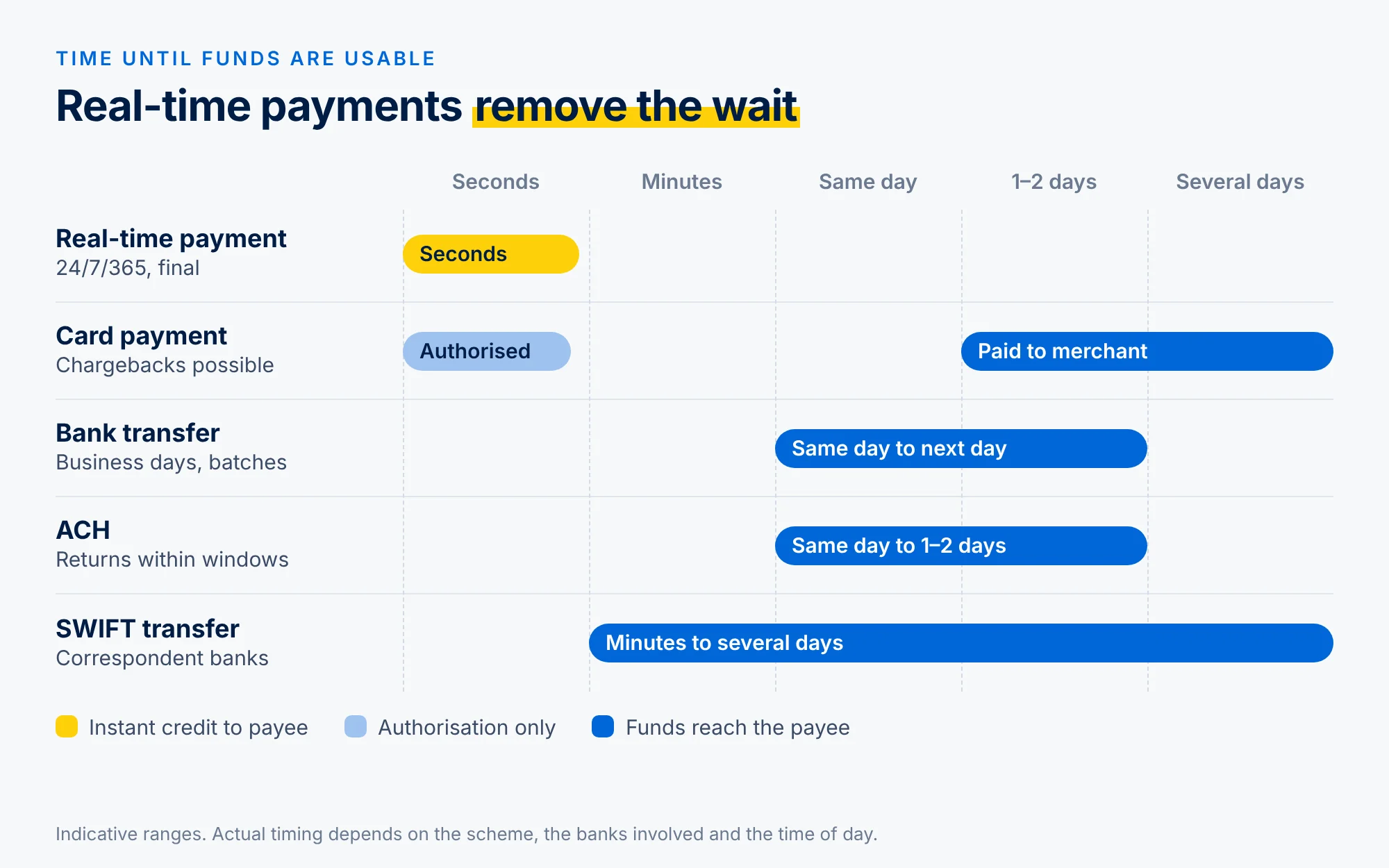
Same-day transfers are faster than traditional transfers but still run in scheduled windows during business hours. Traditional bank transfers, such as standard ACH, are processed in batches and may take one to three business days. An RTP system removes both the batch and the business-hours constraint.
How do real-time payments work?
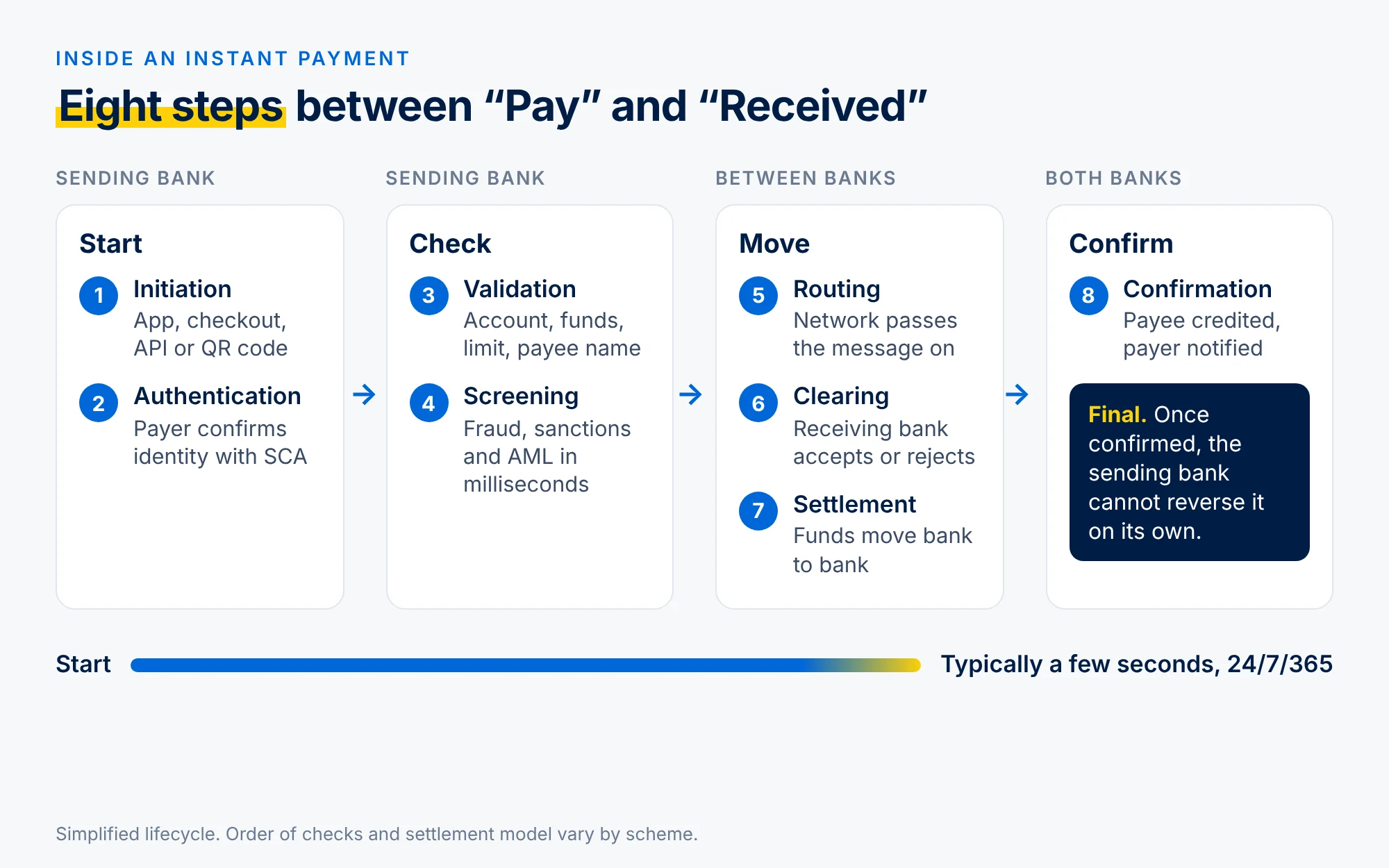
Each national network has its own rulebook, but every RTP transaction follows a similar lifecycle, typically completed in a few seconds:
- Payment initiation. The payer starts a payment in a banking app, at a checkout or through a third-party API, using an account number, a proxy such as a phone number, or a QR code.
- Payer authentication. The sending bank confirms the payer’s identity, often with strong customer authentication such as biometrics plus a device-bound credential.
- Payment validation. The bank checks that the account exists, holds sufficient funds and that the amount is within the applicable transaction limit. Many markets now also verify the payee’s name against the account before the payment is sent.
- Fraud and compliance checks. Real-time fraud scoring, sanctions screening and anti-money-laundering rules run within milliseconds, because there is no overnight review window.
- Routing through the payment network. The transaction message goes to the central infrastructure, which routes it to the receiving bank.
- Clearing. The receiving bank checks the instruction and accepts or rejects it.
- Settlement. Funds move between the two banks, either one payment at a time in central bank money or against prefunded positions.
- Confirmation. Both banks receive a status message; the payee is credited and the payer is told the payment succeeded.
Only participating banks and payment institutions can send or receive this type of payment. If the payee’s bank is not reachable, the transaction cannot complete in real time and the sending bank may fall back to a slower rail. That is why coverage matters as much as speed when you choose a payment provider or RTP solution.
Key features of instant payment infrastructure
Instant payment infrastructure shares a set of design features, whatever the country:
- Continuous availability: the network, and every participant connected to it, must operate 24/7/365, with maintenance handled without downtime windows.
- Near-immediate processing: scheme rules set a maximum end-to-end time; SEPA Instant, for example, targets ten seconds.
- Payment confirmation: sender and receiver get a definitive positive or negative response instead of a pending status.
- Settlement finality: a confirmed payment is irrevocable at the scheme level.
- Transaction limits: schemes set a maximum, and each bank may apply lower limits per customer, channel or time of day.
- Security requirements: authentication, message signing and real-time monitoring are mandatory, not optional.
- Interoperability: common message formats, increasingly ISO 20022, let institutions and overlay services connect consistently.
Availability still varies in practice. A network may run around the clock, but an individual bank can set lower limits, exclude certain account types or route some payments through a slower system. A business should treat “instant” as a property of a specific bank, account and amount, not of a whole country.
Major real-time payment systems around the world
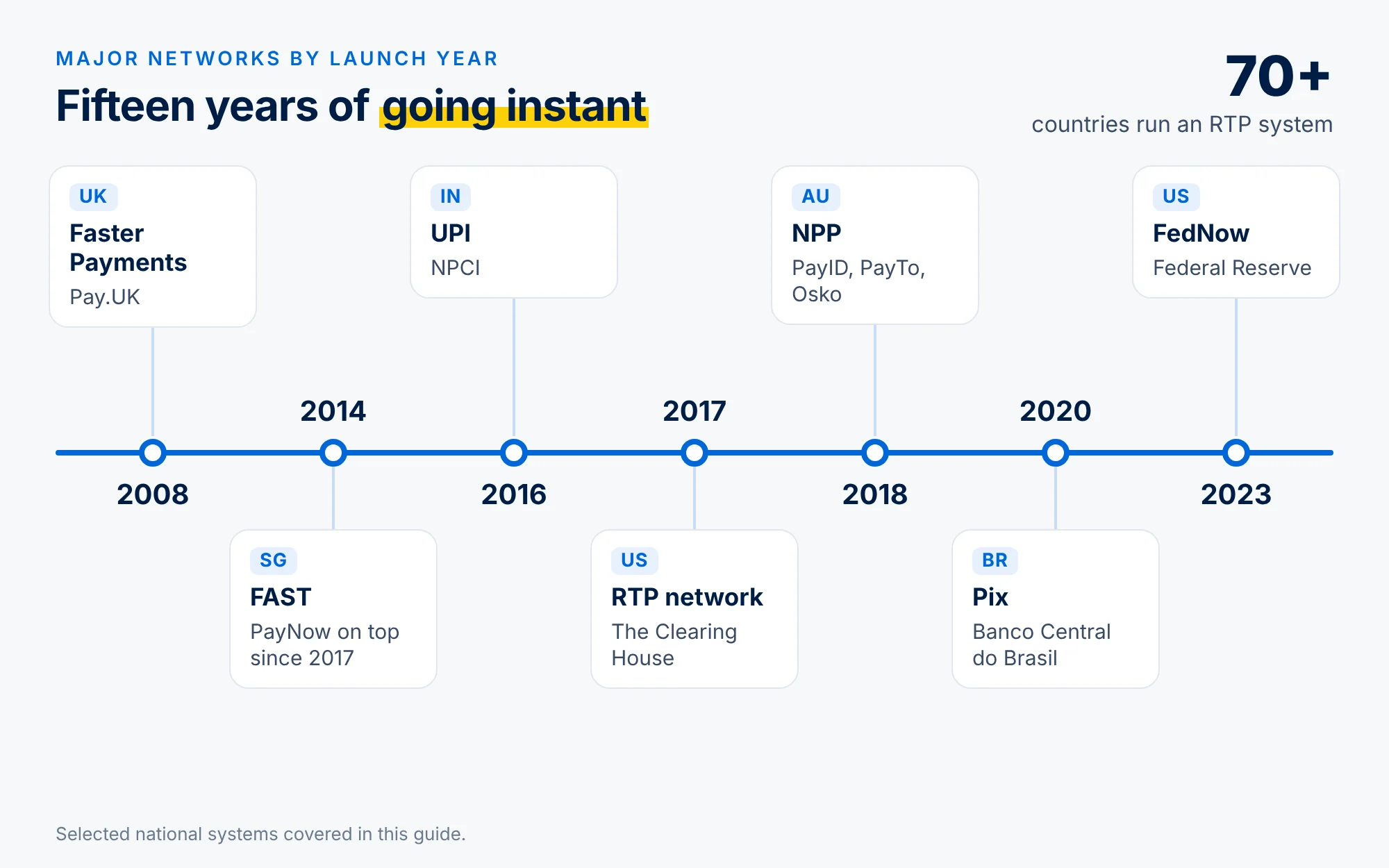
More than 70 countries now run an RTP system. The networks below are among the most established. For each one, separate the clearing and settlement infrastructure from the payment interfaces and overlay services that customers actually see.
United Kingdom — Faster Payments
Launched in 2008, Faster Payments was one of the first national instant payment systems. It is operated under Pay.UK, and payments settle in central bank money at the Bank of England in several cycles a day, with participant positions secured by prefunding so recipients can be credited immediately. Directly connected banks and building societies provide access, and many smaller firms reach the network through indirect access providers. Payees are identified by sort code and account number, checked through Confirmation of Payee. Faster Payments carries mobile banking transfers, bill payments and standing orders, and it is the rail behind most UK open banking payments.
European Union — SEPA Instant Credit Transfer and TIPS
SEPA Instant Credit Transfer (SCT Inst) is a scheme rulebook managed by the European Payments Council, not a single network. It defines how a euro credit transfer reaches the payee within ten seconds across the 36 SEPA countries. The underlying clearing and settlement happens on infrastructures such as TARGET Instant Payment Settlement (TIPS), run by the Eurosystem, which settles each payment in central bank money, and RT1, operated by EBA Clearing. Payees are identified by IBAN. Under the EU Instant Payments Regulation, payment service providers in the euro area that offer standard credit transfers must also offer instant ones, at no higher price, together with Verification of Payee. For businesses, this turns SEPA Instant into a common way to pay suppliers and receive customer funds across borders inside Europe. Our overview of open banking coverage across Europe shows how this reach looks country by country.
United States — FedNow and The Clearing House RTP Network
The US has two instant payment networks. The RTP network, launched by The Clearing House in 2017, is privately owned by large banks and settles on a joint account held at the Federal Reserve. The FedNow Service, launched by the Federal Reserve in 2023, settles payments in participants’ master accounts. Both use ISO 20022 messaging and support request for payment. Participation is voluntary, so reach depends on which of the country’s many banks and credit unions have joined each network. Common business use cases include payroll and gig-worker payouts, insurance claims and bill payment.
Brazil — Pix
Pix, created by the Banco Central do Brasil and launched in 2020, is both the network and the brand. The central bank owns the rules and the settlement system, and large institutions are required to participate, which explains its rapid adoption. Payees use a Pix key such as a tax ID, phone number, email or random key, or a QR code. Pix is used for person-to-person transfers, business payments in store and online, and tax and utility payments, with a special return mechanism for fraud cases.
India — Unified Payments Interface (UPI)
UPI, run by the National Payments Corporation of India since 2016, is best understood as an interface layer. It lets customers link several bank accounts to one app and pay with a virtual payment address or QR code, while interbank processing runs on NPCI infrastructure and settlement happens through accounts at the Reserve Bank of India in multiple cycles a day. UPI handles billions of transactions each month, from small merchant QR payments to peer-to-peer transfers, and supports recurring mandates.
Singapore — FAST and PayNow
FAST (Fast and Secure Transfers), introduced in 2014, is Singapore’s interbank instant credit transfer system. PayNow, launched in 2017, is an overlay service on top of it that lets people and companies receive money using a mobile number, national ID or business entity number instead of an account number. PayNow has also been linked with India’s UPI, an early bilateral cross-border link.
Australia — New Payments Platform (NPP)
Australia’s New Payments Platform went live in 2018 and is operated by Australian Payments Plus. Each payment settles individually in real time through the Reserve Bank of Australia’s Fast Settlement Service. Customers can address payments with a PayID, such as a phone number or ABN, and PayTo adds authorised, mandated payments that businesses can use instead of direct debit. Overlay services such as Osko use the same platform, a model similar to Singapore’s.
Comparison of global instant payment systems
The table summarises how the networks differ. Limits change over time and banks often apply lower limits than the scheme maximum, so verify current scheme-specific figures before you rely on them in a product.
| System | Coverage and currency | Hours and speed | Transaction limits | Payee identifier | Typical use cases |
|---|---|---|---|---|---|
| Faster Payments | United Kingdom, GBP | 24/7, usually seconds | Scheme maximum; banks set lower limits | Sort code and account number | P2P, bills, open banking checkout |
| SEPA Instant / TIPS | 36 SEPA countries, EUR | 24/7, within 10 seconds | No scheme cap; PSPs and users may set limits | IBAN | Supplier payments, payouts, A2A checkout |
| FedNow and RTP | United States, USD | 24/7, seconds | Network caps; banks set lower limits | Routing and account number | Payroll, claims, bill pay |
| Pix | Brazil, BRL | 24/7, seconds | Set by institutions, lower at night | Pix key or QR code | P2P, retail, tax and utility payments |
| UPI | India, INR | 24/7, seconds | Per-transaction caps, higher for some categories | UPI ID or QR code | Merchant QR, P2P, mandates |
| FAST and PayNow | Singapore, SGD | 24/7, seconds | Scheme cap; banks set lower limits | Account number, mobile number or UEN | P2P, business collections |
| NPP | Australia, AUD | 24/7, seconds | Set by institutions | BSB and account, or PayID | P2P, PayTo mandates, payouts |
Real-time payments vs traditional payment methods
Instant payments compete with methods that businesses already know well. The main differences are in timing, settlement and how much can be undone after the fact.
| Method | Processing time | Settlement | Availability | Intermediaries | Reversibility |
|---|---|---|---|---|---|
| Real-time payments | Seconds | Immediate or secured in real time | 24/7/365 | Sending bank, network, receiving bank | Final; recovery only by request |
| Standard bank transfer | Same day to next business day | Batch | Business days | Banks and clearing system | Limited once processed |
| ACH | Same day to 1–2 business days | Batch, deferred net | Business-day windows | Originating bank, operator, receiving bank | Returns allowed within defined windows |
| SWIFT-based international transfer | Minutes to several days | Through correspondent accounts | Depends on each bank and time zone | Often several correspondent banks | Recall by request only |
| Card payment | Authorised in seconds | Settled to merchant in days | 24/7 authorisation | Acquirer, card scheme, issuer | Chargebacks possible |
SWIFT deserves a clarification. It is a financial messaging network: it carries payment instructions between banks, but it does not move or settle money itself. Settlement happens across the banks’ correspondent accounts and, ultimately, in the relevant domestic systems, which is why international transfers can still take time. Cards give customers a quick authorisation but leave merchants waiting for settlement and paying interchange and scheme fees; the transaction cost of an account-to-account RTP payment is often lower.
Benefits of real-time payments for businesses and consumers
The value of real-time payments comes from removing the gap between a payment being sent and the money being usable. For consumers, that means wages, refunds and transfers that arrive when they are needed. For a business, the benefits are operational:
- Immediate fund availability: money received can be used the same minute, including evenings and weekends.
- Improved cash flow management: treasury teams get accurate, real-time insights into balances and incoming transactions instead of waiting for batch files.
- Faster supplier payments: paying on the due date rather than days ahead keeps cash in the business longer and strengthens supplier relationships.
- Quicker customer refunds: refunds reach the customer’s bank account in seconds, which reduces support contacts.
- Fewer delays: a definitive confirmation replaces “pending” statuses and manual chasing, and payment data gives finance teams clearer insights for forecasting.
Practical examples show how this plays out:
- An e-commerce business accepts an account-to-account payment at checkout and ships the order as soon as it confirms that the funds have arrived. Our guide to open banking payments for merchants covers this flow in more detail.
- A marketplace pays sellers or drivers immediately after each job instead of in a weekly batch.
- A fintech platform lets users top up a wallet instantly, improving activation.
- A financial institution disburses loans in real time as a core banking service.
Challenges and risks of instant payments
Speed brings new risks. Because there is no batch window to stop a suspicious payment, every control has to work in real time:
- Payment fraud: authorised push payment scams, where a victim is tricked into sending money, are a significant problem for instant payment networks.
- Mistaken transfers: a wrong account number can send funds to the wrong person, which is why payee verification services matter.
- Limited recovery options: finality means the sender cannot simply reverse the payment; recovery depends on the receiving bank and the recipient.
- Liquidity management: banks need funds available around the clock, including weekends.
- Infrastructure availability: an outage at one participant affects customers immediately and visibly.
- Transaction limits: limits can block large payments, so a business may need another rail for them.
- Compliance requirements: sanctions screening and AML monitoring must run in milliseconds.
Effective real-time monitoring is therefore part of the service, not an extra. Banks and payment providers combine behavioural analytics, device data and network-level insights to score each transaction before release. Several markets now require reimbursement of fraud victims, which shifts incentives further towards prevention. When you assess an RTP solution, ask what risk insights it exposes to your own team.
Real-time payments and open banking
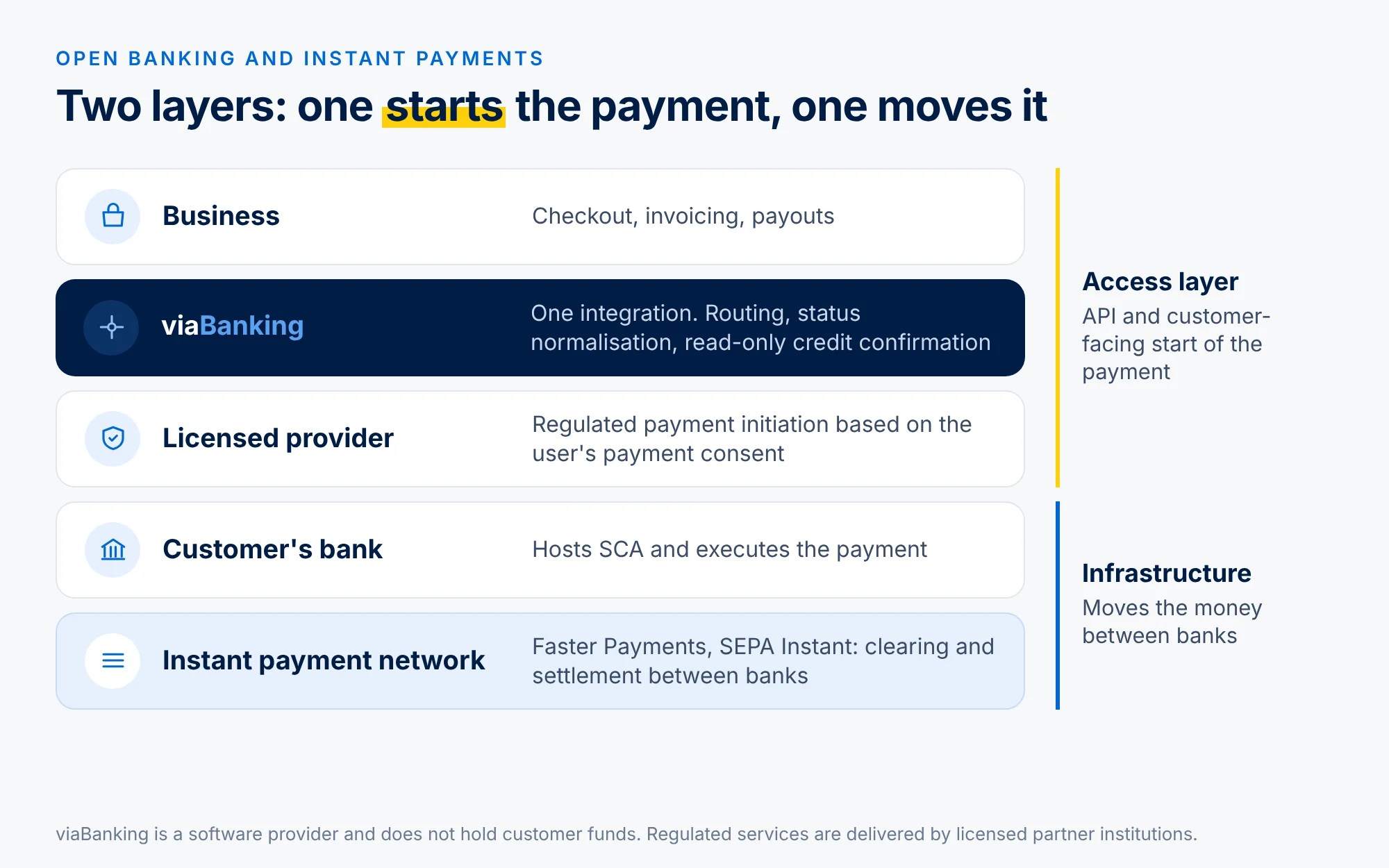
Open banking gives third parties regulated, customer-authorised access to bank accounts through APIs. In payments, that access comes through payment initiation services: a licensed provider sends a payment instruction to the customer’s bank, the customer authenticates there, and the bank executes the payment on whichever rail it uses, often the domestic instant payment network.
It is important to keep the layers apart. The payment initiation layer is the customer-facing access point and the API; the clearing and settlement infrastructure, such as Faster Payments or SEPA Instant, moves the money between banks. A payment initiation service does not replace a payment network; it gives businesses a standard way to start a payment on one. viaBanking works as an orchestration solution above licensed providers: one integration that routes requests, normalises payment statuses and confirms when funds arrive, without holding customer funds.
That combination opens up several opportunities:
- Embedded payments inside invoicing, accounting or booking software.
- Automated financial workflows, where a payment is triggered by an event and reconciled from the status callback, feeding cash-flow insights.
- Account-to-account transactions that avoid card fees and give merchants faster access to funds.
Cross-border real-time payments
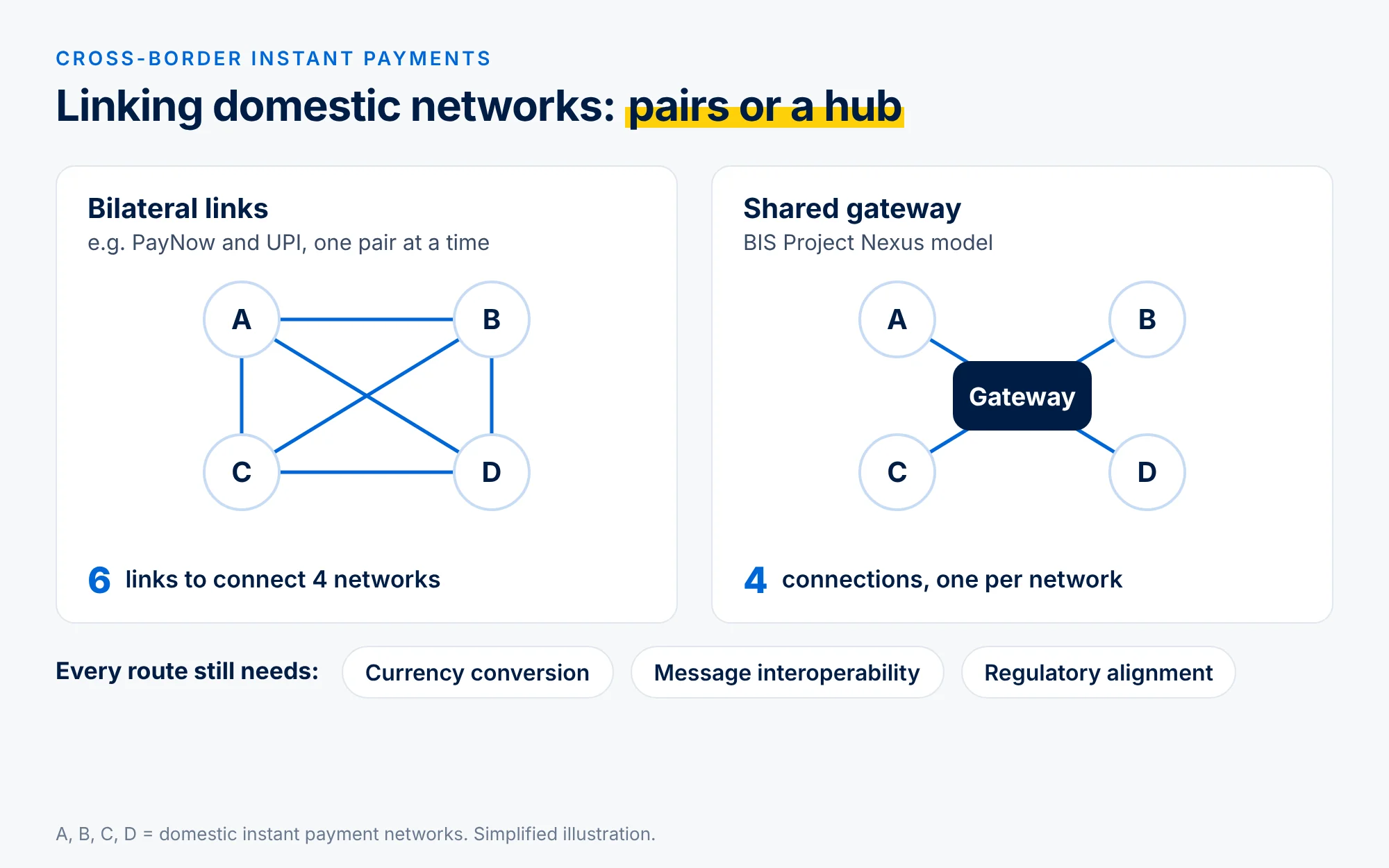
A domestic RTP network does not make an international transfer instant. Each one settles in its own currency, follows its own rules and only reaches its own participants. Connecting them requires:
- Currency conversion, with a foreign exchange provider quoting and delivering the rate.
- Interoperability between different message formats, identifiers and operating hours.
- Regulatory alignment, as sanctions, AML and data rules differ between jurisdictions.
Bilateral links, such as the one between Singapore’s PayNow and India’s UPI, solve this for one pair of countries at a time. BIS Project Nexus, started at the Bank for International Settlements Innovation Hub, takes a different approach: a standard gateway that a domestic network connects to once to reach every other connected system. A group of Asian central banks has since moved the work towards live operation.
Regulatory developments and the future of instant payments
Regulation is now the main driver of adoption. In the European Union, the Instant Payments Regulation requires payment service providers in the euro area to send and receive SEPA instant payments, to charge no more than for standard credit transfers, and to offer Verification of Payee, which checks the payee’s name against the IBAN before a payment is sent. Other markets, including the UK with Confirmation of Payee, apply similar checks.
ISO 20022 is becoming the common financial messaging standard. SWIFT’s coexistence period for cross-border payment instructions ended in November 2025, and most modern instant payment networks use the standard natively. Richer, structured data makes screening, reconciliation and interoperability between national networks easier.
For payment providers and businesses, instant payments are becoming the default rather than a premium option. The practical question is how to connect to them reliably. Our open banking API overview explains how one integration can reach this infrastructure across several European markets.
Choosing a real-time payment solution
RTP schemes differ in currency, limits and identifiers, but they share one transaction lifecycle and the same need for real-time fraud controls. When comparing solution options, check:
- which banks and RTP networks the solution reaches in your markets;
- how payment statuses and confirmed arrival are reported to your business;
- what fraud, payee verification and risk insights are included in the service;
- how refunds and failed transactions are handled.
Frequently asked questions
- What is a real-time payment system?
- A real-time payment system is a network that clears and settles credit transfers between accounts at different banks within seconds, 24/7, and makes funds available to the payee immediately.
- How do instant payments work?
- The sending bank authenticates the payer, validates the payment, runs fraud checks and routes it through the network. The receiving bank accepts it, the banks settle and both sides get confirmation within seconds.
- What is the difference between real-time payments and ACH?
- ACH processes payments in batches on business days, so funds arrive the same day or within one to two days. RTP payments settle individually within seconds, at any hour, and are final once confirmed.
- Are real-time payments available 24/7?
- The networks operate 24/7/365, but availability for a specific payment depends on whether both banks participate, the account type and the limits each bank applies.
- Which countries have instant payment systems?
- More than 70 countries run one, including the UK, the euro area countries, the United States, Brazil, India, Singapore and Australia.
- Can real-time payments be reversed?
- Not unilaterally. A confirmed instant payment is final; recovery depends on a request to the receiving bank or on market-specific return and reimbursement rules.
- Can instant payments be used for international transfers?
- Domestic networks only work within their own currency and participants. International transfers need currency conversion and links between networks, such as BIS Project Nexus, so most are not yet instant.
Related reading
Variable Recurring Payments (VRP) and A2A Payments in Open Banking
Variable recurring bank payments let customers authorise future bank payments within agreed limits.
What Is Pay by Bank, and How Does It Work?
Pay by bank moves money straight from a customer’s account to a business.
What Is Open Finance and How Does It Work?
See how open finance links financial data and services with customer permission.